
On World Day for Safety and Health at Work (28 April), the role of safety in Mine Action deserves particular recognition.
In humanitarian demining, safety is the framework that governs every task, every movement, and every operational decision. International Mine Action Standards make clear that no clearance activity should proceed unless hazards have been assessed, controls are in place, and personnel are fully prepared.
In Yemen, where years of conflict have left large areas contaminated by landmines, unexploded ordnance, and other explosive hazards, these principles carry even greater importance. Teams often work in difficult terrain, remote locations, and communities where people urgently need safe access to roads, farmland, schools, and homes. In such conditions, strong health and safety systems are essential both for protecting personnel and for sustaining humanitarian operations.
Project Masam applies these standards through structured field procedures that begin long before clearance starts. Survey teams gather information from local communities, historical records, and previous task data to understand the nature of contamination. Terrain, access routes, soil conditions, and likely threat types are all reviewed before any technical work is authorised.
Every working day starts with operational briefings. Team leaders review the task plan, known risks, weather conditions, communications procedures, medical arrangements, and the responsibilities of each team member. Worksites are checked, lanes are marked, and supervisors confirm that safe distances and approved methods are in place before any clearance begins – even when working on the same minefield as the previous day.
Protective equipment forms one visible part of this system. Deminers rely on visors, protective clothing, detectors, excavation tools, radios, and medical kits that must remain fully serviceable. Routine inspections of detectors, batteries, vehicles, and protective gear help ensure that equipment failures do not create avoidable risk in hazardous areas.
Health protection is equally important. Yemen’s climate can expose personnel to extreme heat, dehydration, fatigue, and physically demanding conditions that affect concentration and performance. Project Masam manages these risks through hydration measures, monitored work-rest cycles, shaded recovery periods where possible, and close supervision of personnel wellbeing throughout the day.
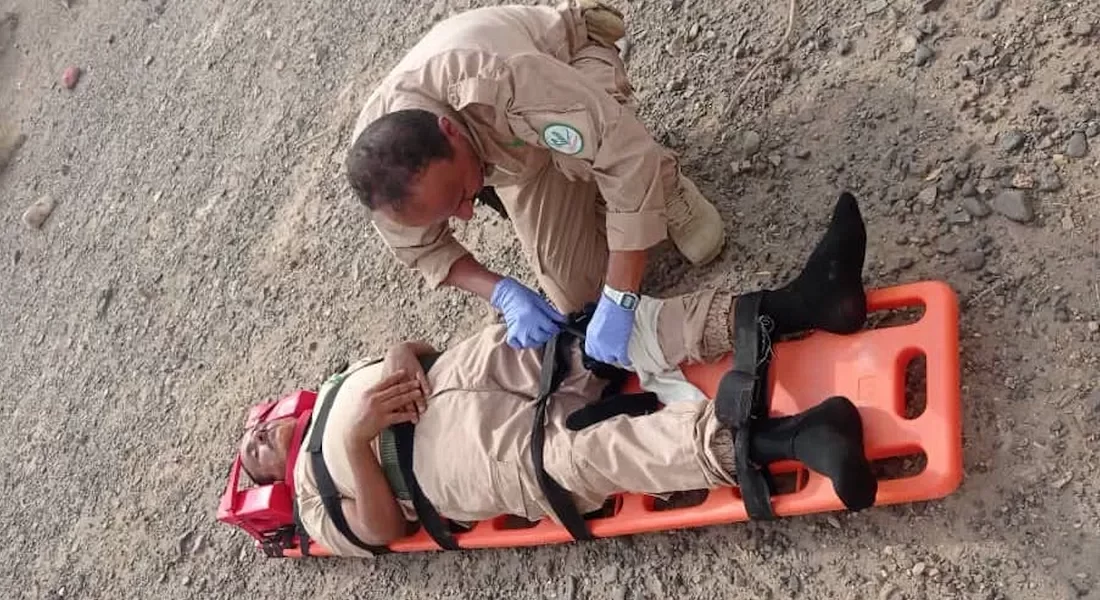
Each demining team is supported by a dedicated medic who provides immediate first-response capability in the field. Ambulances are maintained in operational readiness so that casualty evacuation can take place without delay if required. Emergency procedures are rehearsed regularly, and communications systems are tested to ensure rapid coordination in the event of an incident, in what has been described as one of the most perilous environments for humanitarian workers by Theyab Al-Dabba, a member of Project Masam’s medical team..
Another important part of safe Mine Action is the management of demolitions and bulk demolitions for items that cannot be safely moved or require controlled destruction. Within Project Masam, demolition operations are conducted under strict procedures covering storage, transport, handling, security distances, initiation systems, and site control. Demolition tasks require careful planning to ensure the safety of personnel, nearby communities, and infrastructure.
Before any demolition takes place, teams assess blast effects, fragmentation risk, terrain, weather conditions, and safe access routes. Exclusion zones are established, warnings are issued, communications are confirmed, and all personnel are accounted for before initiation. After detonation, sites are inspected and only reopened when supervisors confirm the area is safe. In this way, demolitions work is carried out as a controlled safety process rather than a routine technical task.
Training remains central to all safe operations. Refresher instruction, and field supervision reinforce correct drills, detector use, excavation techniques, marking procedures, and demolition safety. Near misses, equipment issues, and lessons identified in the field are reviewed so that improvements can be made quickly and standards continuously strengthened. This is especially true in Yemen where demining teams continue to encounter newly-developed booby-trapped mines planted by parties opposing the pro-government forces, including Houthi militias.
Commenting, Ousama Algosaibi, Project Masam’s Managing Director, said: “Health and safety is especially essential in Yemen, where the conflict has continued for years and explosive threats remain across many communities. Our teams operate in demanding conditions, and protecting them is our first responsibility. Strong safety procedures, medical readiness, training, and discipline are what allow humanitarian demining to continue effectively and responsibly.”
Community safety is closely connected to worker safety. Project Masam teams coordinate with local residents and authorities to explain hazardous areas, maintain safe boundaries around worksites, and support the reporting of suspicious items. Reliable community information often improves planning and helps prevent accidents.
The work of Project Masam shows that safety standards are most meaningful when translated into daily practice. Briefings, training, medical preparedness, disciplined procedures, equipment maintenance, and the careful management of demolitions are practical measures that protect lives and enable operations to continue.
On this international day, it is worth recognising that success in Mine Action is measured by explosive threats removed, by the professionalism shown in the field, and by the care taken to protect every member of the team.