
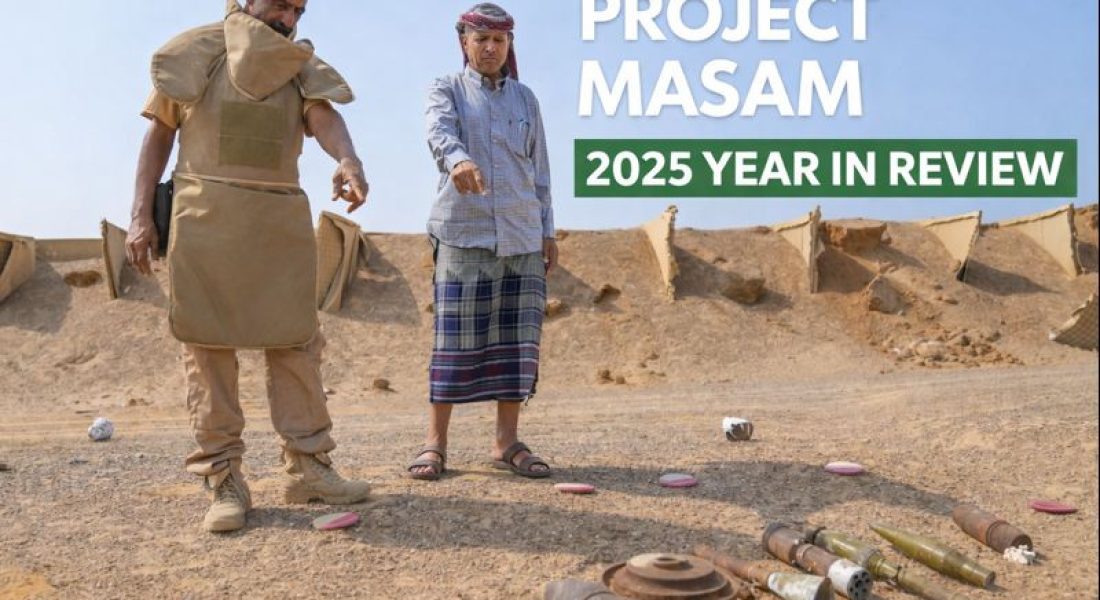
As 2025 comes to an end, Project Masam concludes a year of sustained humanitarian mine action across Yemen’s liberated areas, marked by operational continuity, expanding community engagement, and growing documentation of the human impact of explosive violence.
By late December, Masam demining teams had located and cleared a cumulative total of 529,951 explosive devices since operations began in mid-2018, making more than 75,487,756 square metres of land safe for civilian use across multiple governorates.
Throughout the year, Project Masam continued clearance operations in some of Yemen’s most heavily contaminated districts, including Hajjah Governorate. In Al-Makhzen village in the Midi district, Project Masam Team 38 responded after a civilian, Hassan Bilal, reported suspected mines while grazing livestock. The team conducted a technical survey and secured a minefield that had not previously been recorded. Team leader Engineer Saif Al-Mashmari explained that civilian reporting played a critical role in identifying hidden contamination and preventing potential accidents in frequently used areas.
In another operation in the Midi district, Team 38 cleared banned anti-personnel mines planted in agricultural and grazing land north of the town. According to the team, the mines had restricted movement and livelihoods for local residents, illustrating how explosive contamination continues to affect daily life long after active fighting subsides.
Project Masam’s field operations also supported access to essential services. In Al-Rama area in Al-Mokha district, Taiz Governorate, Project Masam Team 21 secured farmland and a nearby water well contaminated with explosive remnants. Following clearance, the land was declared safe for civilian use, allowing residents to resume farming and access water without fear. Team members noted that securing water sources remained a priority in areas where contamination had disrupted basic services.
In Shabwah Governorate, Project Masam demining teams cleared a minefield in the Khalidiya area of Usaylan district to enable the construction of a water well intended to serve hundreds of people. During the operation, teams removed large numbers of anti-vehicle mines. Local resident Saleh Salem Al-Harthi said that clearing roads, farmland and grazing areas restored a sense of safety and would support livelihoods and agricultural activity in the area.
Beyond clearance, Project Masam intensified explosive ordnance risk education activities during 2025, particularly along Yemen’s west coast. Teams conducted awareness sessions in communities affected by contamination, explaining how to recognise explosive hazards and report them safely. Our deminers, who work in the area, reported that these campaigns led to increased civilian reporting and reduced risky behaviour, strengthening cooperation between communities and demining teams.
Victim assistance and survivor engagement in 2025
Project Masam’s work in 2025 extended beyond clearance and advocacy to include direct time spent with survivors and families of victims, responding to their needs, listening to their experiences, and supporting them in accessing services.
In Haradh district, Hajjah Governorate, the story of Taha Atin, a young shepherd injured by a landmine, underscored the long-term impact of explosive violence on families and youth. Our teams visited Taha and his family in their village, listening to his account of the incident and its aftermath. Project Masam personnel provided emotional support, discussed ongoing safety measures, and helped signpost the family with medical and rehabilitation services available locally – which could include referrals to partners such as KSRelief – ensuring continuity of care beyond emergency treatment.
In the same governorate, Project Masam met with the family of Fatima Hirani, who suffered life-altering injuries from explosive remnants. Teams spent time with Fatima and her relatives in their home in Hiran District, listening to her story and discussing the challenges she faced in daily life, education and mobility. The project’s engagement included signposting to community-based services and organisations that provide specialized support, and discussing strategies to improve household safety and reduce isolation.
Project Masam also worked with the family of Ali Hakami, another survivor of explosive violence in Abs District, northern Hajjah. Project Masam teams visited Ali’s community to hear his family’s concerns about ongoing contamination and the psychological toll of living in a high-risk environment. The discussions included reviewing safety practices around explosive hazards and offering referrals to local health and psychosocial support services.
In Abs district still, our teams met with Ilham Sahili, a 13 years old girl who lost her legs, and mobility, due to an explosive incident near her home as she was heading to the grazing fields. Teams listened to Ilham’s account and spent time understanding the barriers she faced in accessing basic services and continuing her education. Project Masam provided information about rehabilitation and disability support programmes operating in the region and discussed how risk education can help protect others in her community from similar harm.
These engagements emphasised Project Masam’s commitment to not only locating and clearing explosive hazards but also engaging survivors and their families with dignity. In each case, teams focused on listening to firsthand experiences, recording evidence, providing immediate on-the-ground support, and signposting to healthcare providers, rehabilitation services, and humanitarian partners including KSRelief, where appropriate.
Reflecting on this engagement with survivors and affected families, Managing Director Ousama Algosaibi said that mine action must remain grounded in the experiences of those living with the consequences of explosive violence. He noted that spending time with survivors, listening to their stories and helping connect them to support services was an essential part of Project Masam’s responsibility, alongside clearance itself. He added that documenting harm and responding to civilian needs strengthens both the humanitarian impact and the integrity of mine action operations.
Advocacy: Gender, disability, water and environment
Alongside field operations, Project Masam placed increased emphasis in 2025 on advocacy and public awareness around the broader humanitarian consequences of explosive contamination, which is a pillar of Mine Action.
Through a series of published articles and international awareness days, Project Masam highlighted how mines and explosive remnants of war affect different groups in distinct and often compounding ways.
First, gender-specific risks featured prominently in Project Masam’s advocacy during the year. On the International Day to End Violence Against Women and Girls, the project drew attention to how explosive contamination disproportionately affects women and girls, particularly in rural and displacement settings.
We highlighted that women and girls are often exposed to risk while collecting water, firewood or food, or while caring for livestock, tasks that require regular movement through contaminated areas. The reporting underscored that explosive hazards increase protection risks and restrict access to essential services, reinforcing the need for clearance strategies and risk education activities that take gendered patterns of movement into account.
Secondly, disability and long-term injury were also central themes to our advocacy work in 2025. We published analysis on how survivors of explosive incidents frequently face lasting barriers to mobility, education and employment, particularly in areas with limited accessible infrastructure. The advocacy highlighted that explosive violence not only causes injury, but can deepen exclusion for people with disabilities when contaminated land, damaged infrastructure and inaccessible services overlap. Project Masam also emphasised the importance of linking clearance with inclusive planning, risk education and survivor-centred approaches to reduce long-term social and economic impacts.
Water access emerged as another recurring focus of both operations and advocacy. Project Masam documented how explosive contamination around wells, pipelines and water points restricts access to safe water, particularly in rural and drought-affected areas.
Clearance operations in support of water infrastructure were presented as essential to reducing daily risks and supporting public health. Advocacy messaging stressed that securing land for water projects is a critical humanitarian priority, especially for women and children who bear the primary responsibility for water collection.
Environmental impact was addressed through Project Masam’s engagement around the International Day for the Environment in War and Armed Conflict. The project highlighted how mines and unexploded ordnance contaminate soil, restrict grazing and farming, and delay environmental recovery long after fighting ends. Project Masam’s reporting linked clearance to environmental rehabilitation, noting that removing explosive hazards allows land to be reused safely for agriculture, grazing and natural regeneration, while reducing long-term ecological damage.
Across these advocacy areas, Project Masam consistently highlighted the role of clearance as an enabling activity rather than an end in itself. The project emphasised that sustained mine action supports humanitarian access, protection outcomes and recovery when it is coordinated with local authorities, communities and humanitarian partners.
This approach was reflected not only in Project Masam’s advocacy, but also in how its work was viewed at the local and national levels.
Senior Yemeni officials and local authorities publicly recognised Project Masam’s humanitarian contribution during the year. In Hajjah Governorate, members of the Shura Council praised the project’s expanding demining efforts and their impact on civilian safety. In other public statements, officials highlighted how clearance operations supported stability, enabled safer movement and facilitated the return of services in liberated areas.
Project Masam’s work also received acknowledgement at the national level.
Yemeni leadership, including President Dr. Rashad Mohammed Al-Alimi, Chairman of Yemen’s Presidential Leadership Council, commended the continuation and expansion of the project’s humanitarian mission, noting that mine clearance had reduced risks to civilians and supported recovery efforts across multiple governorates. In a statement, Al-Alimi said of our clearance operations, “This great humanitarian effort by our brothers in the Kingdom, through the Masam project, which has so far removed nearly 500,000 landmines and various explosive devices, embodies a noble fraternal commitment to Yemen and its people, and contributes to alleviating the suffering caused by the war ignited by the Iranian-backed terrorist Houthi militias.”
Local authorities echoed these views, stressing that sustained clearance remained essential for protecting communities and rebuilding trust and cooperation in affected areas – which remained a recurring theme throughout 2025.
Project Masam field updates documented how demining teams worked closely with residents, local leaders and authorities to identify contaminated areas, encourage handing in of explosive items, and prioritise clearance. This collaboration, including our long-standing one with Yemen Executive Mine Action Centre (YEMAC, Yemen’s national mine action authority), was described as essential to effective mine action, particularly in areas where contamination patterns were complex or undocumented.
Based on its operational experience in 2025, Project Masam pointed to practical priorities including maintaining locally tailored risk education, prioritising clearance around essential services such as water points and schools, strengthening civilian reporting mechanisms, ensuring that clearance efforts consider the needs of women, girls and people with disabilities, supporting survivors through referral pathways to appropriate services, and reinforcing the importance of documenting violations (including alleged war crimes) and advocating for accountability and justice for civilian harm as part of a comprehensive humanitarian response.
Through our reporting, we also underscored the importance of continued documentation and awareness to ensure that the humanitarian impact of explosive contamination remains visible at local, national and international levels.
Operationally, 2025 was defined by consistency, as Project Masam teams continued working through extreme heat, difficult terrain, dense vegetation and fluctuating security conditions. By December alone, Project Masam cleared 3,491 explosive items and secured more than 1.4 million square metres of land. These results reflected cumulative effort sustained throughout the year rather than isolated milestones.
Reflecting on the year, Project Masam leadership emphasised that progress in 2025 was built on sustained field presence, strict safety standards and experienced teams operating continuously in high-risk environments. Maintaining consistency and discipline was described as essential to reducing long-term risks for civilians and ensuring clearance remains effective in complex conditions.
As Project Masam enters 2026, its teams do so amid ongoing humanitarian pressures across Yemen. Continued explosive contamination, displacement and strain on civilian infrastructure underscore the persistent risks faced by communities in affected areas.
In this context, clearance remains essential to enabling humanitarian access, reducing threats to displaced and returning populations, and protecting civilians as conditions continue to change. The progress achieved in 2025 provides a strong operational foundation for sustaining this work in support of safety, access and recovery in the year ahead.