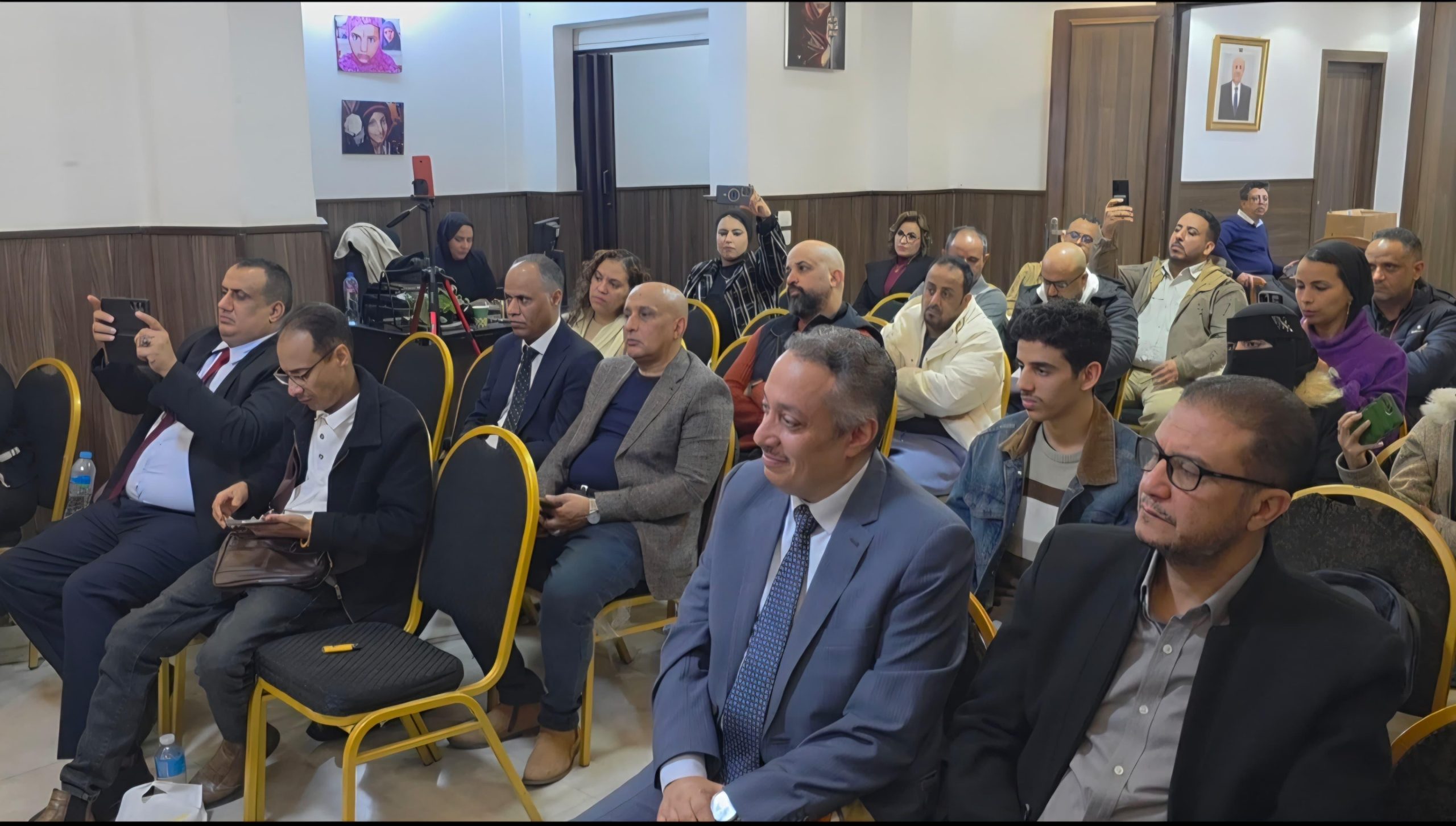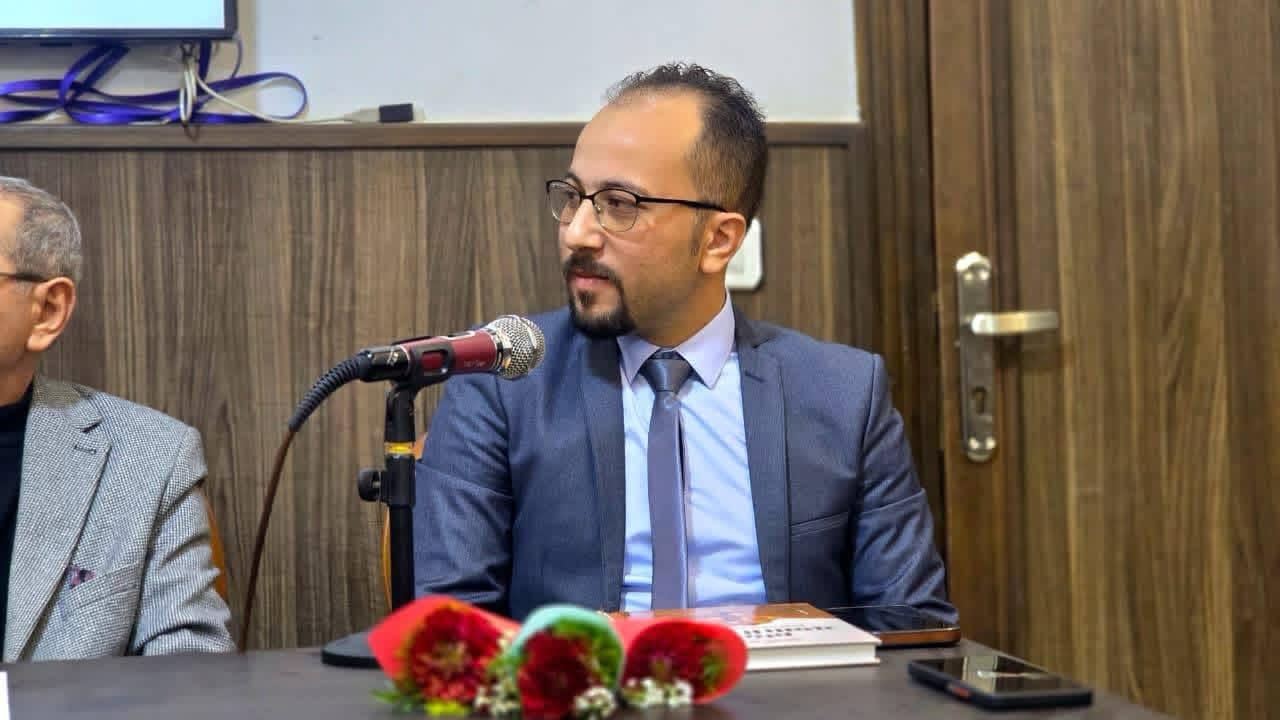
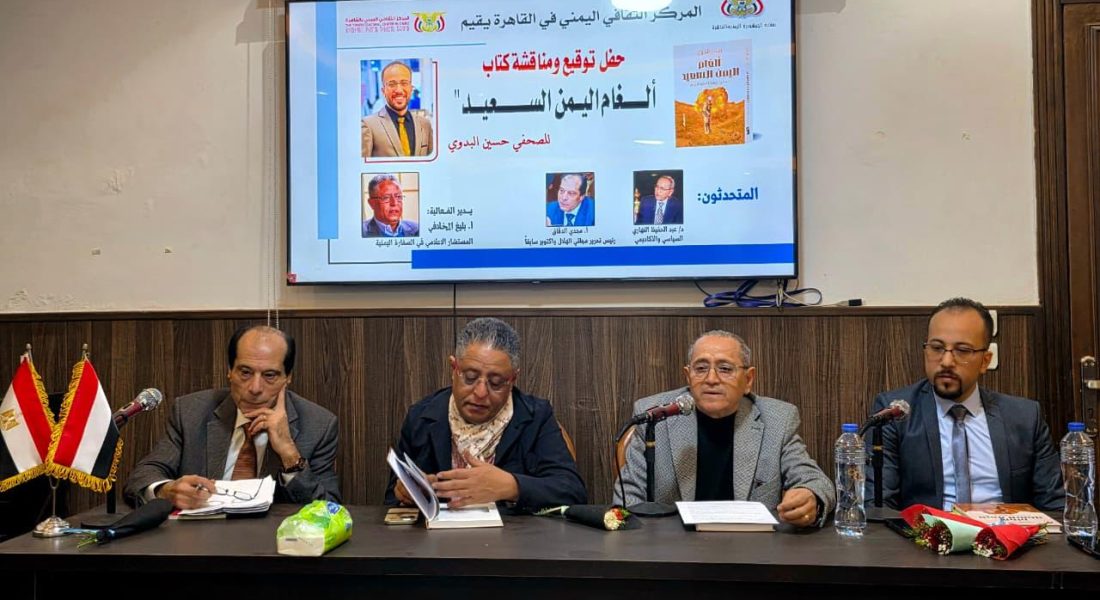
The Cultural Center at the Embassy of the Republic of Yemen in Egypt has hosted a book signing and discussion event for the book The Landmines of Happy Yemen: Witnessing War on the Front Lines of Hell by journalist Hussein Al-Badawi, published by Dar Al-Ain.
The 333-page book documents the author’s experiences and reporting from mine-contaminated areas across Yemen.
The discussion panel included Egyptian journalist Magdi Al-Daqqaq, former editor-in-chief of Al-Hilal and October magazines, and Yemeni media figure and politician Dr. Abdul-Hafiz Al-Nahari. The event was moderated by Baligh Al-Mekhlafi, Media Advisor at the Embassy of the Republic of Yemen in Cairo, and was attended by journalists, intellectuals, and individuals interested in humanitarian issues.
During the discussion, Hussein Al-Badawi described the widespread planting of landmines during the war in Yemen as a form of silent killing that has affected all aspects of life. He explained that landmines have not only caused deaths and injuries but have also disrupted livelihoods, displaced communities, and prevented the use of land for farming, housing, and infrastructure.
Al-Badawi spoke about his personal journey through mine-contaminated areas, noting his shock upon discovering that large sections of Aden International Airport had been planted with landmines. He said that landmines do not distinguish between people, animals, or the environment, and that their impact constitutes a major humanitarian crisis that must be documented and addressed.
He explained that his book presents a detailed journalistic account from one of the regions most affected by conflict following the Arab Spring. He stressed that the book serves as an important record of a humanitarian issue that will continue to require international attention for decades.
The author also praised the work of Project Masam, stating that its teams have played a critical role in reducing the threat posed by landmines and explosive remnants of war. He noted that 30 demining personnel, including five foreign experts, have lost their lives during clearance operations, reflecting the high risks involved in this work.
Al-Badawi said that Project Masam demining teams have removed approximately 530,000 landmines, unexploded ordnance, and improvised explosive devices (IEDs). He added that these included mines disguised as rocks, children’s toys, and personal items. According to him, more than 75 million square metres of land have been cleared since operations began in mid-2018.
He further explained that while landmines are traditionally used in military contexts to restrict movement, Houthi militias have used them in ways that deliberately target civilians. He pointed to the use of devices fitted with electric pressure plates that can be detonated by minimal contact, including by children or livestock.
Al-Mekhlafi said that militias planted mines across Yemen without providing maps or records, which has complicated clearance efforts and increased the risks to civilians. He noted that Al-Badawi’s book documents this issue in detail and provides a valuable reference for researchers, journalists, and those working on humanitarian and security issues. He added that the book relies heavily on first-hand testimonies from victims and concludes with recommendations aimed at reducing the long-term impact of landmine contamination.
Meanwhile, Al-Daqqaq spoke about the risks taken by the author to complete the book, describing it as a rare example of investigative journalism conducted directly in dangerous environments. He said the work documents one of the most serious humanitarian crimes of the modern era and also warns of broader social divisions that threaten Yemen’s future.
Al-Nahari also referred to the title of the book, explaining that it highlights the contrast between the idea of a peaceful Yemen and the reality of widespread landmine contamination. He emphasised that landmines remain dangerous long after conflicts end and continue to cause humanitarian and developmental damage for decades. He said the book draws attention to the practice of planting mines without documentation and the ongoing suffering this causes.
Al-Nahari also discussed the international Mine Ban Convention, to which Yemen is a signatory, and the legal prohibition on the use of landmines. He reviewed local and international demining efforts, including the role of the King Salman Humanitarian Aid and Relief Center and the Masam Landmine Clearance Project. He stressed that contaminated land continues to block development and that reconstruction efforts cannot proceed without effective mine clearance.
The book The Landmines of Happy Yemen has recently been presented at several international book fairs, including those in Riyadh, Amman, Sharjah, Kuwait, Iraq, and Jeddah, which took place from 11 to 20 December 2025. It is also scheduled to participate in the Cairo International Book Fair from 21 January to 3 February 2026.